Wesley So's 48-game unbeaten run ends in the last round and he still takes a fourth U.S. title in a playoff, Rachael Li wins the women's championship at 16 on her debut, Bayegan Pendik take the European Club Cup on tiebreak, and Bodhana Sivanandan becomes the youngest female IM in history.
Coverage window: after 10:45 Sofia time on October 21 through 10:45 on October 24, 2026.
Wesley So's 48-game unbeaten run at the U.S. Championship ended in the last round, and he won his fourth title the next evening anyway. Rachael Li, 16, took the women's championship on her debut. In Budva, Bayegan Pendik won the European Club Cup from Novy Bor on tiebreak, Monte-Carlo kept the women's cup, and Bodhana Sivanandan became the youngest female international master in history.
So's 48-game run ends, and the fourth title comes a night later
Both U.S. titles are 12-player round robins at the Saint Louis Chess Club, played October 9 to 22 at 90 minutes for 40 moves plus 30 minutes. The open carries $250,000, with $55,000 for first; the women's event $152,000, with $35,000 for first. 1
So came into the final round a point clear and needed a draw with black against Sam Sevian, who was last on 2½/10 and had not won a game all tournament. 2
Sevian had never lost to So at a classical time control: two wins and twelve draws in their fourteen previous classical games. He got an advantage in the Nimzo-Indian, reached a winning rook endgame, and spoiled it into a draw. So then spoiled the drawn position into a loss. 2
Fabiano Caruana had called his own chances "essentially zero" the day before, and had to win with white against Awonder Liang to force a playoff. He did, on the strength of a 6.Bf4 idea in the Tarrasch that his second, Grigoriy Oparin, had shown him. 2 3
Three games were decisive. Oparin drew Ray Robson in a Ruy Lopez and finished half a point short of the playoff. Jeffery Xiong beat Hans Niemann with black; Niemann ended on 4/11, lost 20 rating points and dropped out of the 2700 club. 2
The playoff was two rapid games at 15+10, the next evening. In the first, So opened with an 11...Nb6!? novelty that looked like a blunder and invited Caruana to take a piece; Caruana declined, and after 72 moves the game was drawn. So had missed a forced win on move 34. 4
In the second, Caruana chose a speculative gambit with black, got nothing for the pawn, and blundered a piece. So won the game and the match 1½–½. 4
"I think I only slept for two or three hours, and I was not in the mood to play today at all," So said afterwards. "I don't think I deserved to win this year, but I'll take it of course." 4
Caruana's own reading was blunter. "I have lost about 110 Elo points in a year," he said. "But I don't know what's been going on. I haven't been able to find my form." 4
The title is So's fourth, after 2017, 2020 and 2021, and came with $56,000. 5
Five players took the places for the next FIDE World Cup: Caruana, So, Oparin, Xiong and Andy Woodward. 3
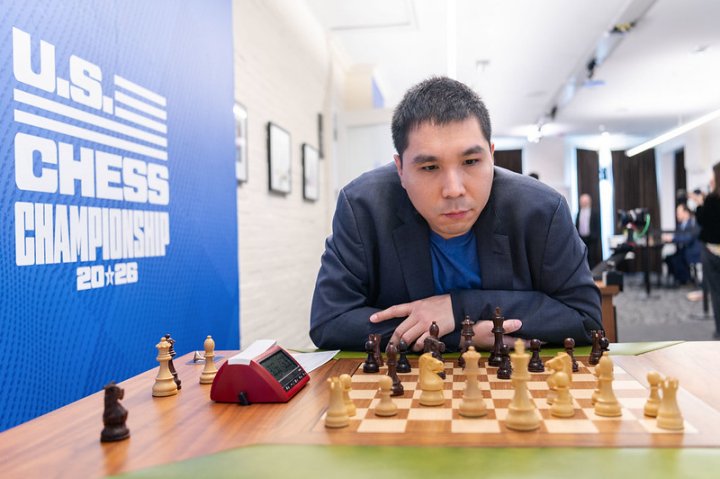
Wesley So in the final round in Saint Louis, the game he lost to Samuel Sevian. He beat Fabiano Caruana in a rapid playoff the next evening. Photo: Crystal Fuller / Saint Louis Chess Club, via ChessBase.
Final standings, open section, after 11 rounds. Ratings are the invitational ratings published for the event; players level on score share a place. 6
| Pos |
Player |
Rating |
Score |
| 1 |
Wesley So |
2796 |
7 |
| 1 |
Fabiano Caruana |
2831 |
7 |
| 3 |
Grigoriy Oparin |
2683 |
6½ |
| 3 |
Jeffery Xiong |
2693 |
6½ |
| 5 |
Andy Woodward |
2685 |
6 |
| 6 |
Levon Aronian |
2768 |
5½ |
| 6 |
Awonder Liang |
2753 |
5½ |
| 6 |
Abhimanyu Mishra |
2686 |
5½ |
| 9 |
Sam Shankland |
2692 |
5 |
| 10 |
Hans Niemann |
2770 |
4 |
| 10 |
Ray Robson |
2701 |
4 |
| 12 |
Samuel Sevian |
2736 |
3½ |
Li takes the women's title at 16, on her first attempt
Rachael Li led by a point on 8/10 and needed a draw against Anna Zatonskih. She got it in 49 moves, from an opposite-coloured bishop endgame that had been level for a long time. 7
The game very nearly ended after 14 moves. Zatonskih could have forced a threefold repetition and chose not to, because, as she put it in the confessional booth, repeating the position "would be unfair to Alice Lee". 3
Alice Lee, one point behind, did her part: she beat Anna Sargsyan with black, holding her position together with 28...Qe8! against a two-pawn sacrifice. Li said later that she would have declined the repetition too. 3
Li is the youngest player to win the title on a debut. Irina Krush is still the youngest champion ever, at 14. 7
Her prize money totalled $45,000: the $35,000 first prize, a $5,000 winner's bonus and the $5,000 Finish Strong award for the best score over the last six rounds. 7
She also earned her first IM norm, gained about 50 rating points over the event, and qualified for the next Women's World Cup alongside Lee, who took $30,000. 3
Behind them, Krush beat Tatev Abrahamyan to take third outright, and Rose Atwell beat Nazi Paikidze with a queen sacrifice. Carissa Yip, the defending champion, drew Jennifer Yu and finished on 4½. 3
Final standings, women's section, after 11 rounds. 8
| Pos |
Player |
Rating |
Score |
| 1 |
Rachael Li |
2382 |
8½ |
| 2 |
Alice Lee |
2465 |
8 |
| 3 |
Irina Krush |
2440 |
7½ |
| 4 |
Thalia Cervantes |
2311 |
6 |
| 4 |
Megan Paragua |
2295 |
6 |
| 6 |
Jennifer Yu |
2373 |
5 |
| 7 |
Carissa Yip |
2505 |
4½ |
| 7 |
Rose Atwell |
2427 |
4½ |
| 7 |
Tatev Abrahamyan |
2417 |
4½ |
| 7 |
Anna Zatonskih |
2358 |
4½ |
| 11 |
Anna Sargsyan |
2404 |
4 |
| 12 |
Nazi Paikidze |
2336 |
3 |
Bayegan Pendik win the club cup, and Novy Bor lose it on the margin
The 41st European Club Cup ran October 17 to 23 in Budva, Montenegro: seven rounds, 108 teams in the open section and 22 in the women's, at 90 minutes for 40 moves plus 30 minutes with a 30-second increment from move one. 9
Three teams came into the last round on 11/12, and two of them met. Bayegan Pendik, the top seeds, beat SuperChess Romania 3½–2½. 10
Anish Giri made the difference on board one. Against Nodirbek Abdusattorov, the highest-rated player in the field, Giri left a rook en prise; Abdusattorov took it, missed the follow-up, and was lost by move 22. Amin Tabatabaei added a second win. 9
Yagiz Kaan Erdogmus, 15, lost to Jorden van Foreest. Low on time, he declined a free a4-pawn, and Giri's verdict afterwards was that "Yagiz is an incredible calculator, so he must have seen too much". 9
Novy Bor beat Elektroprivreda 4½–1½ and finished level with Bayegan on 13 match points. The tiebreak separated them by 8.5, 261.5 to 253. 9
Rishon LeZion A, led by Boris Gelfand, took bronze with a 5½–½ win over Cheddleton Savills Catering. SuperChess Romania, the defending champions, finished fourth and took a place in the 2027 European Chess Super League. 9
Nihal Sarin scored 5/6 for Novy Bor, took gold on board two with a 2859 performance, and rose to a career-best No. 18. Pentala Harikrishna and David Navara also scored 5/6, for silvers on boards three and six. Board one gold went to Marc'Andria Maurizzi. 9
Final standings, open section, top ten. Match points decide the table; the tiebreak column is the organisers' first tiebreak. 9
| Pos |
Seed |
Team |
Match points |
Tiebreak |
| 1 |
1 |
Bayegan Pendik Chess Sports Club |
13 |
261.5 |
| 2 |
4 |
Novy Bor Chess Club |
13 |
253 |
| 3 |
9 |
Rishon LeZion A |
12 |
227.5 |
| 4 |
3 |
SuperChess Romania |
11 |
259 |
| 5 |
5 |
Tuxera Aquaprofit Nagykanizsai |
11 |
239.5 |
| 6 |
2 |
Alkaloid |
11 |
237.5 |
| 7 |
7 |
Ashdod |
11 |
227.5 |
| 8 |
11 |
Aix-en-Provence |
11 |
205 |
| 9 |
10 |
Beer Sheva |
11 |
189 |
| 10 |
8 |
Vugar Gashimov |
10 |
224 |
Monte-Carlo hold the women's cup
Bonnevoie, Monte-Carlo and Odlar Yurdu all came into the last round on 10/12, and none of them had to play each other. 10
Monte-Carlo, the defending champions, won 4–0 against Davit Jojua's Chess Club. The scoreline was kinder than the games: Koneru Humpy was lost against Nia Donghvani until the Georgian missed a tactic with under a minute on the clock. 9
Bonnevoie beat Crvena Zvezda. Odlar Yurdu, who had beaten Bonnevoie the round before, were beaten 3½–½ by Sirmium Sremska Mitrovica. 9
Monte-Carlo and Bonnevoie finished level on 12 match points; Monte-Carlo's tiebreak of 159.5 was 14.5 clear. It is the club's ninth title in the event, and it means Bonnevoie finished second having beaten the first, second and third seeds during the week. 9
The top seven seeds finished in the top seven places. Monte-Carlo also took board golds on one, two and four, through Aleksandra Goryachkina, Koneru and Elisabeth Paehtz. 9
Final standings, women's section, top ten. 9
| Pos |
Seed |
Team |
Match points |
Tiebreak |
| 1 |
1 |
Cercle d'Echecs de Monte-Carlo |
12 |
159.5 |
| 2 |
4 |
CE Gambit Bonnevoie |
12 |
145 |
| 3 |
2 |
Sirmium Sremska Mitrovica |
10 |
136 |
| 4 |
5 |
Odlar Yurdu |
10 |
107 |
| 5 |
3 |
SuperChess Romania |
9 |
117 |
| 6 |
6 |
Gambit ASEE |
8 |
104 |
| 7 |
7 |
Crvena Zvezda |
8 |
103 |
| 8 |
15 |
Davit Jojua's chess club |
8 |
80 |
| 9 |
18 |
Velikova Chess Club |
8 |
65.5 |
| 10 |
8 |
Club Ajedrez Linares |
7 |
90 |
Bodhana Sivanandan is the youngest female IM in history
Bodhana Sivanandan, 11, needed a win with black against Viktoria Johansson of Sweden in the last round for her third international master norm. She got it, finished on 5½/7 on board one for She Plays To Win Lionesses A, and performed at 2465. 11
That makes her the youngest female international master ever, at 11 years, seven months and 16 days. Judit Polgar had held the mark since 1988, when she earned the title at 12. 11
She is the seventh-youngest IM of all time, a month older than Javokhir Sindarov was in 2017 and nearly two months older than Gukesh Dommaraju in 2018, and one of ten players to complete the title before turning 12. 11
Her three norms came in three months. The first was at the Dole Open in July, where she also became the youngest girl to beat a player rated above 2600, Marc'Andria Maurizzi at 2628. The second came at the Olympiad in September, where she scored 8/11 on England's top board. The third was in Budva. 11
She crossed 2400 live during the club cup. Her WGM requirements, met at the Olympiad, are still awaiting formal approval. 11
"I'm happy about that but hopefully I'm able to get grandmaster soon as well!" she said on the broadcast. Asked for the secret behind the run, she said: "No secret!" 11
Malcolm Pein of the English Chess Federation called her "a generational talent". Her coach Mert Erdogdu said he works with her four times a week, alongside John Emms. 11
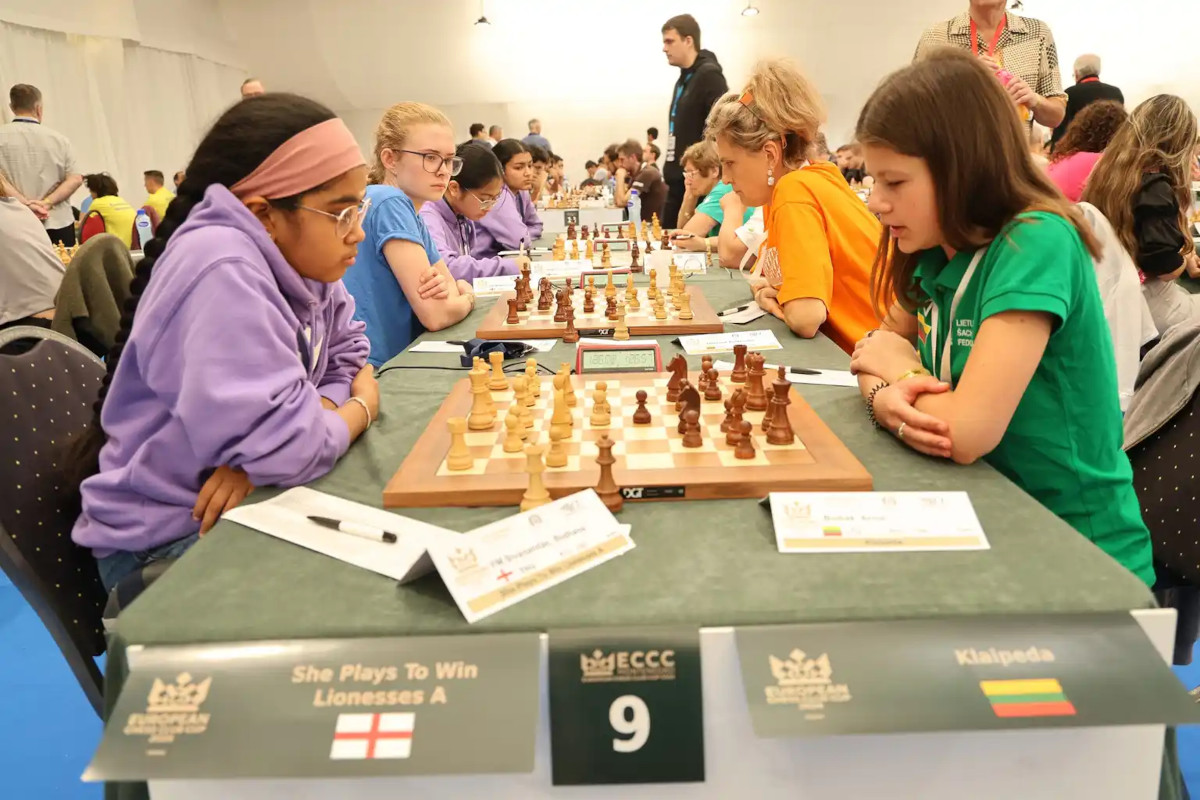
Bodhana Sivanandan, left, against Arina Budiak of Klaipeda in round six of the women's European Club Cup, the fourth of her five wins in Budva. Her team, She Plays To Win Lionesses A, finished 11th of 22, one place above its seeding. Photo: Gerd Densing / ChessBase, via ChessBase.
Three winners on Thursday, a third title on Friday
3 0 Thursday is three 11-round Swiss tournaments at 3+0 every Thursday, with $3,000 across them. 12
Hikaru Nakamura won the first, playing the Goat Horns Variation, 1...a6 and 2...c6, in every black game for 4½/5 with black. He went into the last round on 9/10 and lost to Sina Movahed. Parham Maghsoodloo could have overtaken him and lost to Jeffery Xiong instead, so four players finished on 9 and Nakamura won the tiebreak. 12
The opening came from a ChatGPT advertisement that Lionel Messi posted on October 21 to 517 million Instagram followers, in which the model recommends Goat Horns as fitting his style. 13
Fabiano Caruana, who had just lost the U.S. playoff, won the second tournament with 9½. He won his first five rounds, lost one to Dmitry Andreikin, then won four more and drew the last. 12
Maghsoodloo won the third by 1½ points with 9½, his tenth title in the format. Only Renato Terry, on 18, and Jose Martinez, on 15, have more. 12
On Friday, Hans Niemann won his third Freestyle Friday, scoring nine and beating Movahed on tiebreak, 73.5 to 61.5. Their round-10 game was the decisive one of the event, and Niemann won it. 14
Maghsoodloo was third on 8½ after reaching 6/6, Reza Mahdavi fourth, and Le Thao Nguyen Pham took the women's prize. The winner's cheque was $400. 14
Also this window
- A €300,000 rapid event in Barcelona, with a one-second increment. Magnus Carlsen will headline the first MOVE Cup on January 19–20, 2027: eight players, 10 minutes plus one second a move, a round robin on day one, best-of-three semifinals, a best-of-five final. A €300,000 foundation contribution matches the prize fund. The dates overlap Tata Steel, which runs January 15–31: "It means that I'm not playing next year," Carlsen said of Wijk aan Zee. 15
- Kazakhstan's haul at the World U7–U17. 721 players from 82 countries played 11 rounds in Roquetas de Mar, Spain, across 12 age and gender categories. Milana Filippova won the girls under-11 with 11/11, Danis Kuandykuly the open under-13 with 10½/11, Leila Aldazharova the girls under-7 with 9/11, and Amirzhan Anetov the open under-11. Ukraine's Myron Netrebka took the open under-9 with 9½/11. 16
- Rapid and blitz rating fees waived through 2027. The FIDE Council extended a waiver first introduced for 2021–2024 and now written into the handbook, with waived fees since then approaching €2 million. 17
What to watch next
| Date (Europe/Sofia) |
Event and location |
Checkpoint |
| October 24 |
Bullet Brawl, online |
Nakamura has won the last six and 22 of 23 events this year. 18 |
| October 27–29 |
Clutch Chess Champions Showdown, Saint Louis |
Caruana, Nakamura, Praggnanandhaa and Sindarov play 18 rapid games in three days, with a win worth one, two and then three points; $425,000. First games October 27 at 19:00 Sofia time. 4 |
| October 27 |
Titled Tuesday, online |
Nakamura won the October 20 edition; the perfect-score bounty stands at $5,250 and grows by $250 a week. 19 |
| November 7 |
The 100-0 Project: Daniil Dubov v Josh Smith, online |
100 games of one-minute bullet; Dubov is guaranteed $10,000 and doubles it only by winning every game. 20 |
| November 10–20 |
Total Chess World Championship Tour pilot, Budapest |
A 24-player field in four groups of six, with Carlsen and Caruana among them. 21 |
| November 22–December 13 |
Salesforce FIDE World Championship match, Cologny, Geneva |
Gukesh Dommaraju defends against Javokhir Sindarov over a maximum of 14 games; the first game is November 24. 22 |
This email was sent automatically by your Neodrop notification channel.